 English
 Español
 عربى
عربى1. Space Efficiency: How Does an Expandable Container House Maximize Living Area? Expandable container houses are a re...
READ MOREWhat Makes a Corrugated Container House a Smart Investment? Fixed Container House vs Traditional Cabins
Update:24 Jun 2026
Expert Technical Guide
Deep-dive into thermal performance, interior spatial intelligence, and climate adaptation strategies for fixed container house systems and corrugated container house architecture.
-30%Heat loss reduction
R-24+Spray foam potential
12hrsThermal lag benefit
1. The Thermal Reality: Are Container Homes Insulated Effectively?
One of the most persistent questions about inside a container home is whether standard shipping containers can meet modern building insulation codes. The raw truth: a bare Corten steel shell offers an R-value of just 0.6 per inch, making it a thermal disaster in both summer and winter. However, proper retrofitting transforms the structure entirely. For inside shipping container homes, the key lies in continuous insulation layers that break thermal bridging — a challenge magnified by the corrugated walls.
1.1 Why Steel Conducts Heat (and How to Stop It)
Steel has a thermal conductivity of approximately 50 W/(m·K), which is 1,500 times higher than wood fiberboard. Without intervention, a corrugated container house will act as a giant heat sink. The industry solution involves either spray-applied closed-cell foam (achieving R-6 to R-7 per inch) or structural insulated panels (SIPs) fitted inside the profile. For are container homes insulated to work in extreme climates, you must address the flute cavities of corrugation — these create air channels that undermine batt insulation unless fully filled.
Critical Metric: A 40ft fixed container house without insulation loses 8,000 BTU/hr at -10°C exterior (20°C interior). With 3 inches of closed-cell spray foam (R-21), loss drops to 1,200 BTU/hr — a 85% reduction.
2. Container Home Insulation Types: Performance & Application
Choosing the correct container home insulation types determines long-term livability. Below is a comparative analysis based on real retrofitted projects in climate zones 5 and 6 (cold winters).
| Insulation Type | R-value per inch | Corrugation Compatibility | Cold Climate Suitability |
|---|---|---|---|
| Closed-cell spray foam | 6.5 – 7.0 | Excellent (fills flutes) | Best prefab homes for cold climates |
| Polyurethane rigid board | 5.0 – 6.0 | Fair (requires furring strips) | Good with thermal break |
| Rockwool batts | 3.0 – 4.2 | Poor (air gaps likely) | Limited for arctic zones |
| Vacuum insulation panels | R-25 to R-35 | Excellent (thin profile) | Premium solution |
For a fixed container house in northern Sweden or Canada, hybrid strategies work best: 2 inches of closed-cell foam (directly on steel to block condensation) plus 2 inches of polyiso board (for added R-value). This approach prevents interstitial condensation — a common failure point when only vapor-permeable materials are used.
The diagram above illustrates a typical high-performance assembly for inside a container home. Note the continuous air barrier created by spray foam, which also solves the condensation risk on the corrugated steel — a common pitfall in inside shipping container homes.
3. Small Space Interior Design for Fixed Container Houses
Designing small space interior design for a fixed container house requires a shift from conventional residential layouts. The narrow width (typically 2.4m internally for standard units) demands multifunctional zoning and vertical expansion strategies.
3.1 Zoning Without Walls
Use floor level changes, ceiling treatments, or light coves to distinguish sleeping, living, and cooking areas. One proven tactic: raise the sleeping platform 16 inches to incorporate under-bed storage drawers and separate the zone via a partial-height partition that also acts as a headboard.
3.2 Mirrors, Gloss Finishes, and Linear Lines
High-gloss cabinet fronts and full-height mirrors on end walls create visual depth. A luxury container interior often features continuous LED strip lighting along the ceiling-corner junction, which elongates the perceived length. For a corrugated container house, exposing a single ribbed wall as an accent — treated with clear polyurethane — adds texture without sacrificing spatial efficiency.
Case Insight: A 20ft fixed container house retrofit in Vermont achieved 2 bedrooms by implementing a sliding storage core (4ft wide) that houses mechanicals, pantry, and a pull-out desk. Net livable space: 128 sq.ft for living/dining, 70 sq.ft kitchen, and 32 sq.ft bathroom — all while maintaining R-23 insulation envelope.
4. Luxury Container Interior: Materials and Finishes That Work
The term luxury container interior may seem contradictory, but high-end conversions use strategic material selection to offset industrial origins. The key is contrast: warm natural elements against the cold steel structure.
- Thermally broken flooring: Engineered oak flooring over a sleeper system with cork underlayment (adds R-3 and acoustic isolation).
- Wet rooms: Large-format porcelain tiles (24x48 inches) minimize grout lines, making bathrooms feel expansive. Linear drains enable curbless showers — a must for tight spaces.
- Indirect lighting: Cove lighting using 2700K LED strips reduces ceiling dominance and softens the container's rigid geometry.
For best prefab homes for cold climates, luxury also means triple-glazed windows with U-values below 0.8 W/m²K. In a fixed container house, positioning windows on the long south wall and using thermal mass (like a polished concrete floor over the insulation) stabilizes day-night temperature swings.
5. Heating and Cooling Container Homes: System Sizing and Efficiency
Heating and cooling container homes presents unique loads due to the high surface-area-to-volume ratio (for a 40ft unit, it's about 0.9 m²/m³ vs 0.6 for a traditional house). Oversizing equipment leads to short cycling; undersizing fails during extremes. The most effective approach uses a manual J load calculation adapted for steel framing.
5.1 Recommended HVAC Strategies for Cold Climates
- Mini-split heat pumps: Look for models with rated operation at -25°C (-13°F). A 12,000 BTU unit suffices for a well-insulated 320 sq.ft container (R-21 walls, R-30 ceiling).
- Electric radiant film: Installed under floor finish, this provides zonal comfort with zero duct loss. Typical output: 12-15 W/sq.ft.
- Heat recovery ventilator (HRV): Mandatory for airtight conversions. Select a unit with ≥80% sensible recovery efficiency to avoid freezing in the core.
Real performance data: A fixed container house in Montana (climate zone 6B, design temp -23°C) using 2" closed-cell foam + 2" polyiso required only 4,200 BTU/hr heating load — 60% less than an identical but uninsulated steel building. Annual heating cost: $280 (electricity at $0.11/kWh).
For inside shipping container homes, avoid ducted systems — they consume precious interior volume. Instead, use cassette-style mini-splits mounted on the long wall, directing airflow along the corridor. Also, never block the corrugation flutes if using passive stack ventilation; instead, incorporate a continuous ridge vent in a false ceiling plenum.
6. Best Prefab Homes for Cold Climates: Why Containers Compete
When evaluating best prefab homes for cold climates, container-based designs are often compared to timber-framed modular units. Containers offer inherent structural strength for high snow loads (up to 350 psf with standard ribbing) and transportability. However, the thermal envelope must be designed with extreme care. The ranking factors for cold-climate suitability include:
| Criteria | Insulated Container Home | Timber Modular |
|---|---|---|
| Thermal bridging control | Needs continuous exterior/interior insulation | Better (wood studs) |
| Air leakage @50Pa | 0.6 ACH achievable (spray foam) | 1.5-3 ACH typical |
| Snow load resistance | Excellent (steel monocoque) | Requires heavy timber |
| Permeability control | Simple (steel = perfect vapor barrier) | Complex layers needed |
A well-executed corrugated container house with spray foam and an HRV outperforms many stick-built cabins in air tightness and durability. The defining factor for best prefab homes for cold climates is not the material alone — it's the continuity of insulation and elimination of thermal shorts around door frames and corner castings.
7. Construction Details: Avoiding Common Failures Inside Container Homes
From experience, most problems in inside a container home arise from four mistakes: inadequate condensation planning, uninsulated corner castings, thermal bridging through floor channels, and poor window installation. Below are technical countermeasures.
7.1 Fixing the Floor Channel Bridge
The bottom rail of a container is a continuous steel member. If you screw interior flooring directly to it, you create a massive thermal bridge. Solution: install a thermal break layer — 1/2-inch phenolic foam or a neoprene gasket — between the sleeper and the steel. Then add 3 inches of rigid insulation between sleepers.
7.2 Window Pocket Insulation
Standard window openings cut into corrugated steel leave bare steel edges. Wrap each rough opening with a butyl tape then spray foam the jamb to a depth of at least 2 inches. For inside shipping container homes in arctic zones, use internally mounted triple-glazed windows with thermally broken frames.
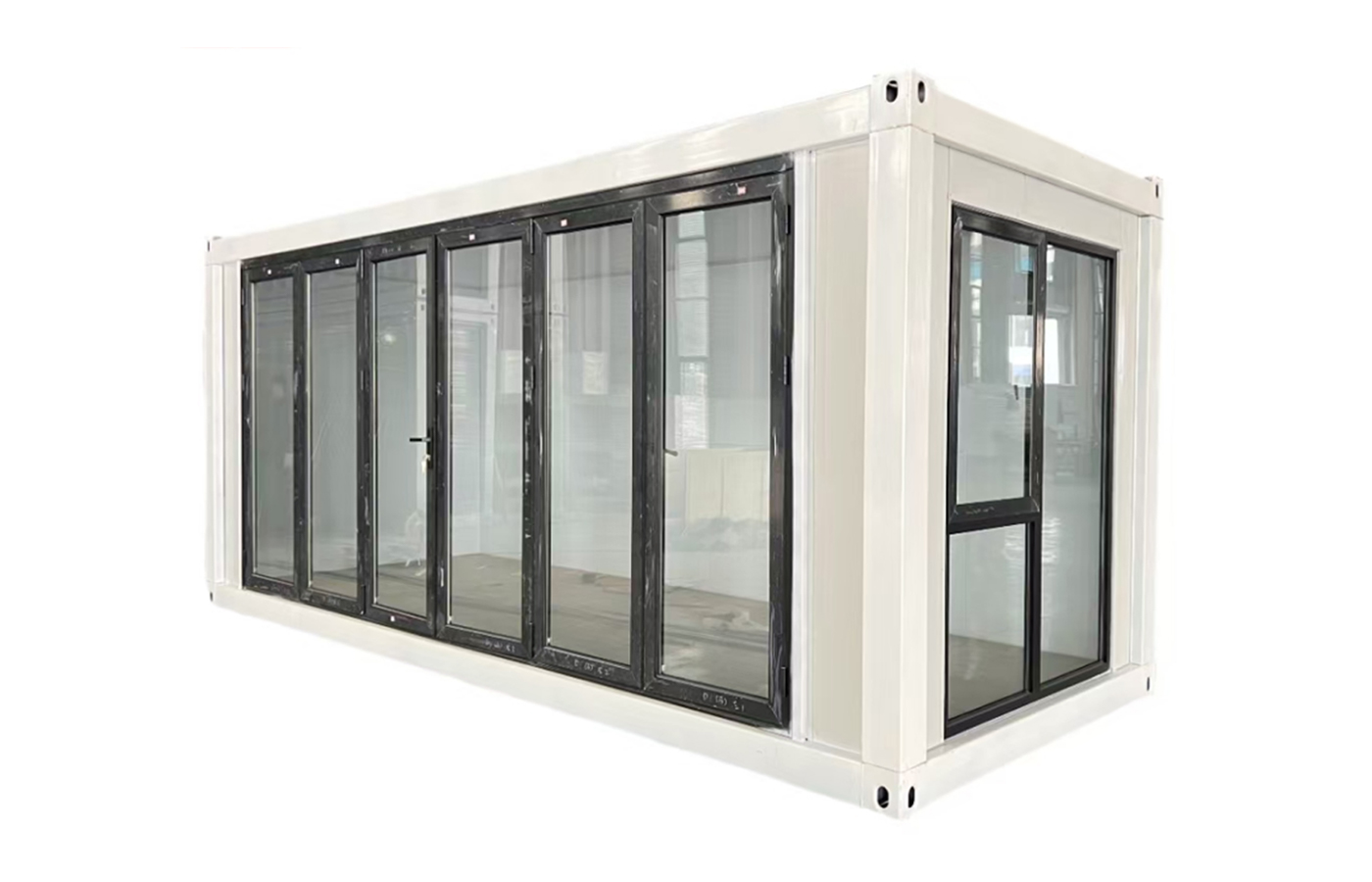
The above image illustrates a completed interior of a fixed container house where all thermal strategies have been integrated — note the recessed lighting plane (allows overhead insulation depth) and the flush window reveals with no steel exposure.
8. Frequently Asked Questions (Technical Focus)
Q1: What is the most effective insulation for a corrugated container house to prevent condensation?
Closed-cell spray foam remains the gold standard because it adheres directly to the steel, filling every flute and forming a monolithic vapor barrier. Open-cell foam or batts allow humid interior air to reach the cold steel surface, leading to hidden rust and mold inside the walls. For cold climates, ensure at least 2 inches of closed-cell foam (R-13 minimum) on all steel surfaces.
Q2: How do you size heating equipment for a fixed container house in zone 5?
Perform a rough heat loss calculation: multiply total exterior surface area (walls+roof+floor) by the temperature difference (design indoor 21°C minus outdoor minimum) and divide by the assembly R-value. For a 20ft container (160 sq.ft floor) with R-21 walls, R-30 roof, and R-15 floor, the loss is approximately 3,500 BTU/hr at -15°C outdoor. A 6,000 BTU/hr mini-split provides safe oversizing for defrost cycles without short cycling.
Q3: Are shipping container homes allowed in cold climate building codes?
Yes, when they meet or exceed IRC or IECC requirements for thermal envelope, egress, and ventilation. Most jurisdictions classify them as "modular" or "tiny homes" provided an licensed engineer stamps the insulation assembly and structural modifications. The key is demonstrating that the are container homes insulated question is answered with verifiable R-values and a continuous air barrier test (blower door ≤3 ACH50).
Q4: What is the typical cost premium for a luxury container interior suitable for -30°C winters?
Material and labor for insulation and HVAC upgrades add roughly $85-$120 per sq.ft above basic container conversion costs. The largest line items: closed-cell foam application ($3.50-$5 per board foot), triple-glazed windows ($800-$1,200 each), and an HRV system ($1,200-$2,000). However, energy savings of 65-80% compared to uninsulated steel structures yield a payback period of 3-6 years in heating-dominated regions.
Q5: Can I use radiant floor heating inside a container home?
Yes, hydronic or electric radiant floors work excellently provided the insulation layer is at least R-15 below the heating elements. Use an uncoupling membrane (e.g., cement board with thermal break) over the steel floor structure to prevent downward heat loss. For heating and cooling container homes, radiant floors should be paired with a mini-split for cooling, as radiant alone cannot provide summertime cooling without condensation risks.
News
GET A QUOTE
Contact Us Now

We can do OEM and ODM to meet all your detailed requirements. Allstar will be your choice. You are warmly welcome to visit and consult!
Our Product
Quick Links
Contact Information
- Add: No.218, Calle Xinlou, Pueblo de Qutang, Ciudad de Haian, Provincia de Jiangsu, China.
- E-mail: [email protected]
- Phone: +86-21-67353838
+86-513-88798719
Copyright © 2025 Shanghai Allstar Industrial Co., Ltd. All Rights Reserved.
Customized One-Stop Service Container House Suppliers
 Privacy
Privacy
