 English
 Español
 عربى
عربى1. Space Efficiency: How Does an Expandable Container House Maximize Living Area? Expandable container houses are a re...
READ MOREHow Flat Pack Container Houses Work: Complete Guide to Cost, Setup, and Benefits
Update:04 Jun 2026
The construction industry is experiencing a quiet revolution. Where traditional builds once demanded months of labor, heavy machinery, and unpredictable costs, a new category of structure has emerged that challenges every assumption: the flat pack container house. Shipped in compact panels, assembled in days, and engineered for durability, these structures are reshaping how people think about housing, offices, classrooms, and emergency shelters worldwide.
This guide covers everything you need to know — from what flat pack container houses actually are, to how they are assembled, what they cost, where they excel, and how to determine whether one is right for your project.
What Is a Flat Pack Container House?
A flat pack container house is a prefabricated modular structure manufactured off-site and delivered in a disassembled state — walls, roof panels, floor systems, and structural frames packed flat for efficient transport. Unlike standard shipping container conversions, which repurpose existing steel boxes, flat pack container homes are purpose-built from the ground up using standardized components that interlock or bolt together on-site.
The term "flat packed building" reflects the logistics: panels are stacked horizontally, reducing shipping volume by as much as 70% compared to pre-assembled modules. A single flatbed truck can carry components for multiple units, dramatically lowering freight costs — especially critical for remote sites, island locations, or projects requiring large quantities.
Key Components of a Flat Pack System
- Steel or aluminum frame sections — hot-dip galvanized for corrosion resistance, pre-drilled for bolt assembly
- Sandwich panel walls — composite panels with insulating foam cores (EPS, PU, or rock wool) between steel skins
- Roof panel modules — pitched or flat options, designed with pre-integrated waterproofing layers
- Floor system — steel deck or timber platform mounted on a chassis or concrete footings
- Pre-wired electrical conduits — factory-routed through wall cavities before shipment
- Door and window frames — pre-hung or knock-down, shipped with hardware included
How It Differs from a Standard Container Home
Standard container conversions start with a used or new ISO shipping container — a rigid steel box — and modify it through cutting, welding, and retrofitting. This approach is heavier, less customizable in plan shape, and often more expensive per square foot once insulation, cladding, and finishing are added.
A disassembled container house, by contrast, arrives as raw engineered panels that are optimized from the start for habitation — better insulation values, cleaner wall profiles, and more flexible layouts. The structural logic borrows from container design (modular dimensions, stackability) without the constraints of a repurposed box.
Types and Configurations Available
Flat pack container homes are not a single product — they form an ecosystem of configurations designed for different use cases, budgets, and site conditions. Understanding the main categories helps buyers select the right system before reaching out to manufacturers.
Single-Unit Flat Pack Modules
The baseline offering: a single room or small apartment module, typically 10–40 square meters. Common applications include guard booths, site offices, studio living units, and holiday cabins. A single unit can usually be assembled by 2–4 workers in under 8 hours using basic hand tools.
Multi-Bay Combined Structures
Multiple flat pack modules joined side-by-side or end-to-end to create larger floor plans. This approach enables 2-bedroom homes, open-plan offices, classrooms, and retail spaces without leaving the prefab category. Structural connectors between bays are factory-engineered, maintaining load ratings across the entire assembly.
Multi-Story Stackable Systems
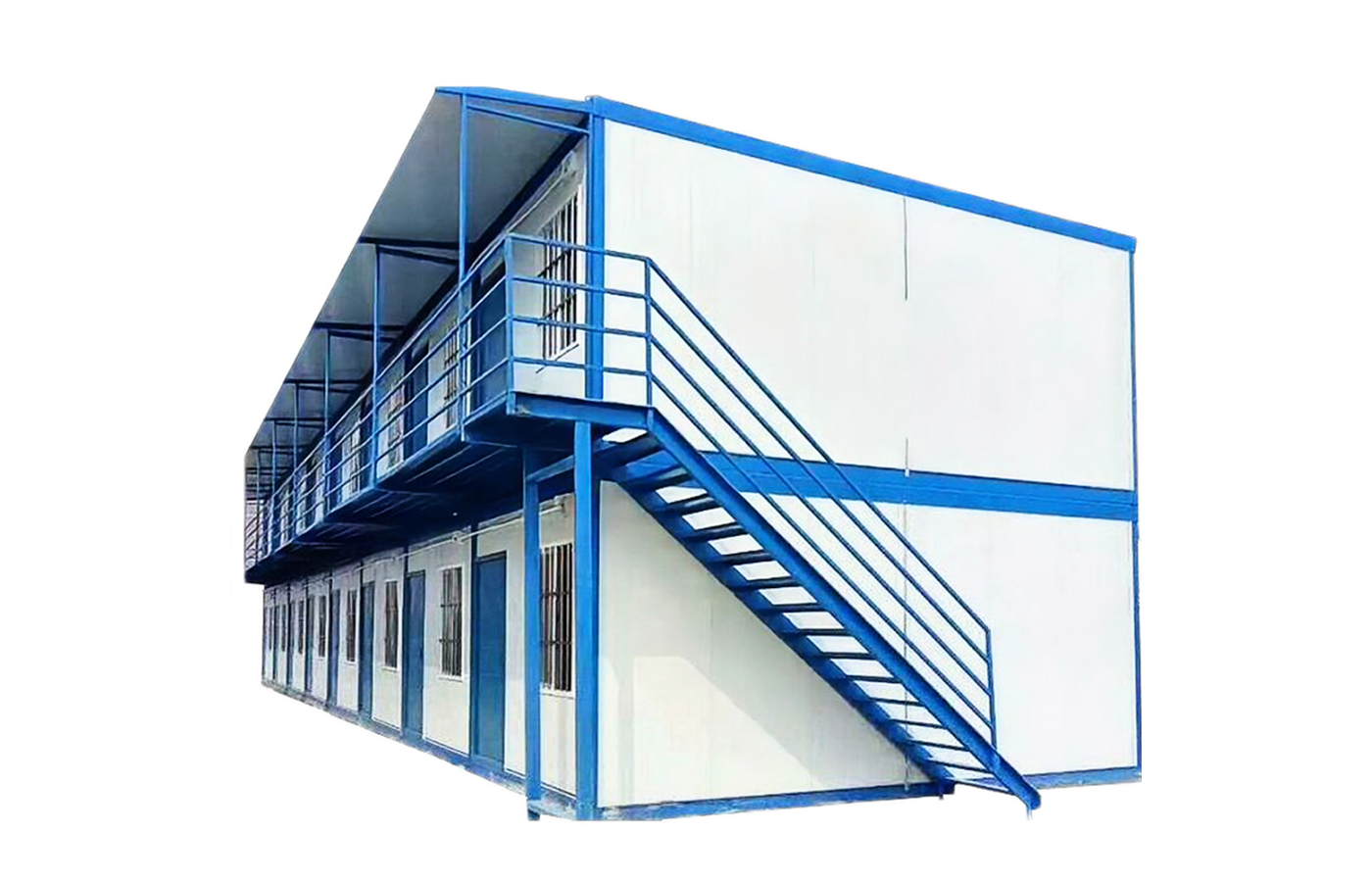
Purpose-designed frames allow flat pack container houses to be stacked two or three stories high, with internal stair cores fabricated as separate flat pack assemblies. Buildings of 6–8 units stacked 2 high are common in worker accommodation camps and budget hotel projects.
Expandable Prefab Pods
A hybrid sub-category where the core module ships in a compact form and side sections fold out or slide out on-site to roughly double the usable floor area. These expandable prefab pods are particularly popular for emergency housing deployments, where rapid floor area is more important than aesthetic flexibility.
Flat Pack Office Pods
Optimized for commercial and professional environments, flat pack office pods ship with pre-integrated cable management, acoustic wall panels, and HVAC-ready penetrations. They can be installed in parking lots, rooftops, or within warehouse complexes to create private workspaces without traditional construction disruption.
| Type | Typical Size (sqm) | Assembly Time | Common Use | Stackable |
|---|---|---|---|---|
| Single Unit | 10 – 40 | 4 – 8 hrs | Studio, Guard Booth, Cabin | Yes (2 stories) |
| Multi-Bay Combined | 40 – 200 | 1 – 3 days | Home, Office, Classroom | Yes |
| Multi-Story | 60 – 500+ | 3 – 14 days | Camp, Hotel, Apartments | Yes (3 stories) |
| Expandable Pod | 15 – 60 | 2 – 6 hrs | Emergency, Remote Site | Limited |
| Office Pod | 10 – 30 | 4 – 8 hrs | Workspaces, Meeting Rooms | Yes |
Step-by-Step Assembly Process
One of the most compelling features of a flat packed building is its assembly logic. Unlike traditional construction, which sequences dozens of trades over months, flat pack assembly follows a linear, predictable process that even a semi-skilled crew can complete safely. Below is a generalized process applicable to most systems on the market.
Phase 1: Site Preparation and Foundation
Flat pack container houses require minimal foundation work compared to conventional builds. Most systems are designed to sit on:
- Concrete pad footings — poured at corner points only, curing within 24–48 hours
- Ground screws (helical piles) — installed in hours, no curing time, minimal ground disturbance
- Adjustable steel piers — ideal for sloped or uneven terrain, leveled mechanically
- Full concrete slab — used where local codes require it or where maximum rigidity is needed
Site clearing, leveling, and foundation installation typically consume the first day of a project. Drainage planning and utility stub-outs should be completed before panels arrive.
Phase 2: Frame Erection
Corner posts and primary beam sections are bolted together using the manufacturer's pre-drilled connection plates. Most systems are designed so that no welding is required on-site — all connections are mechanical. A four-corner frame for a 20sqm unit can be erected by two workers in approximately 3–4 hours.
Phase 3: Panel Installation
Sandwich wall panels clip or bolt into the frame channels, starting at corners and working inward. Panels are keyed so they can only be installed in the correct orientation, reducing errors. Roof panels follow, overlapping in a weatherproof sequence specified in the assembly manual. This phase typically takes 4–8 hours for a single unit.
Phase 4: Doors, Windows, and Weatherproofing
Pre-hung door frames slot into prepared panel openings. Window units — double-glazed in most modern systems — are set into factory-cut apertures and secured with perimeter screws and silicone bead sealing. Junction covers, corner trims, and flashing strips complete the weatherproof envelope.
Phase 5: Mechanical, Electrical, and Plumbing Hook-Up
Pre-routed conduits inside wall panels are connected to the main distribution board. Plumbing lines enter through pre-designated floor penetrations. HVAC units mount on pre-welded brackets on exterior walls. This phase varies in duration depending on the complexity of services required.
Phase 6: Inspection and Handover
A final walkthrough checks panel joint integrity, door and window sealing, electrical continuity, and plumbing pressure. Most projects complete full handover within 5 working days from site start — a timeline impossible to match with traditional construction for equivalent floor area.
Cost Breakdown: What to Expect When Budgeting
Cost transparency is one of the main reasons buyers gravitate toward flat pack container homes. Unlike traditional construction where estimates are frequently revised, flat pack projects allow most costs to be fixed at the design stage. Below is a representative breakdown across different project scales.
| Cost Category | Single Unit (20sqm) | Small Home (60sqm) | Camp Block (300sqm) |
|---|---|---|---|
| Structure & Panels | $8,000 – $15,000 | $22,000 – $40,000 | $90,000 – $160,000 |
| Freight (ex-factory) | $1,200 – $3,500 | $2,500 – $6,000 | $8,000 – $20,000 |
| Foundation | $800 – $2,500 | $2,000 – $8,000 | $10,000 – $35,000 |
| Labor (assembly) | $500 – $2,000 | $1,500 – $5,000 | $6,000 – $18,000 |
| MEP Services | $1,500 – $4,000 | $4,000 – $12,000 | $18,000 – $50,000 |
| Finishes (optional) | $500 – $3,000 | $2,000 – $10,000 | $8,000 – $30,000 |
| Total Estimate | $12,500 – $30,000 | $34,000 – $81,000 | $140,000 – $313,000 |
These figures represent broad global ranges. Actual costs vary significantly by country, local labor rates, site access conditions, and specification level. Projects in remote locations may see freight costs rise to 25–35% of total budget. Buyers who self-manage assembly (the DIY flat pack cabin approach) can reduce labor costs by 60–80% for smaller units.
Cost Factors That Buyers Frequently Overlook
- Import duties and port handling — for international shipments, tariffs on steel panel systems can add 8–20% to the ex-factory cost
- Permits and engineering certification — local building authority approvals may require stamped structural drawings, adding $1,500–$5,000 per project
- Crane or forklift hire — multi-story stacking requires equipment hire for 1–2 days
- Utility connections — bringing grid power, water, and sewer to a greenfield site can dwarf the structure cost in rural areas
- Landscaping and access roads — often budgeted separately but necessary for occupancy
How Flat Pack Compares on a Per-Square-Meter Basis
Traditional residential construction in most developed markets ranges from $1,200 to $3,500 per square meter fully finished. A well-specified flat pack container house typically lands between $500 and $1,200 per square meter including assembly and services — representing a 40–60% cost saving in most scenarios. The gap narrows when high-specification interiors are required.
Core Benefits of Flat Pack Container Houses
70%
Reduction in shipping volume vs. pre-assembled modules
5 Days
Typical on-site assembly time for a full residential unit
50 yrs
Design service life for galvanized steel framed systems
60%
Potential cost saving vs. traditional construction
Speed of Deployment
For projects with tight timelines — disaster relief, mining camps, event infrastructure, school expansions — the assembly speed of flat pack systems is unmatched by any conventional construction method. A 300-square-meter accommodation block that would take 6–8 months to build traditionally can be operational within 3–4 weeks using a flat pack container house system, from first delivery to final inspection.
Exceptional Portability and Reusability
Unlike traditional structures, flat pack container homes can be disassembled, repacked, and redeployed. This is not merely theoretical — it is a commercially important feature for industries like mining, oil and gas, and large-scale events where temporary accommodation is a recurring need. Structures can typically be reassembled 10–15 times before panel fatigue becomes a concern, offering an economic life measured in decades rather than a single use.
Design Flexibility
Because flat pack systems are manufactured to specification, buyers can select from a wide range of panel finishes (brick effect, wood grain, smooth render, corrugated metal), roofline options (monopitch, gable, flat with parapet), and internal configurations. This design flexibility means a quick assembly container structure can look residential, industrial, or commercial depending on the panel selections made at the factory stage.
Environmental Profile
Prefab modular homes of the flat pack variety generate substantially less construction waste than site-built alternatives. Factory manufacturing produces offcuts that can be recycled in the same facility. The thermal performance of well-insulated sandwich panels reduces operational energy use, and at end of life, the steel frame and panel skins are fully recyclable. Some manufacturers offer documented embodied carbon figures that are 30–45% lower than equivalent timber-framed construction.
Quality Control Consistency
Factory production under controlled conditions produces more consistent quality than site construction exposed to weather, variable trade skill levels, and scheduling pressures. Panel thickness, paint adhesion, foam density, and structural weld quality are all tested before despatch rather than inspected retrospectively on a building site.
Scalability
Projects can start with a single flat pack unit and expand incrementally as budget allows. Because the connection logic between modules is standardized, a later extension simply bolts onto the existing structure without structural modification — a property unique to this building category and impossible to replicate with conventional masonry or timber construction.
Real-World Applications Across Industries
Residential Housing
The most visible market for flat pack container homes is affordable residential housing. In regions facing housing shortages — urban peripheries in Southeast Asia, post-disaster zones in the Pacific, and rural areas in Africa — these structures provide permanent or semi-permanent accommodation at price points accessible to middle-income households. A 60-square-meter two-bedroom unit can be fully enclosed and weatherproof in 3 days, providing shelter many months ahead of equivalent traditionally constructed alternatives.
Construction Site Accommodation
Large infrastructure projects — highways, dams, mines, ports — frequently require on-site accommodation for several hundred workers for periods of 2–5 years. Flat pack container houses are the dominant solution in this sector because they can be deployed rapidly at the project start, reconfigured as camp populations change, and fully removed at project completion, leaving no permanent footprint.
Education and Healthcare
Governments and NGOs use flat packed buildings to deploy classrooms, clinics, and administrative offices in underserved regions. A two-classroom school unit (approximately 100 square meters) can be shipped in a single 40ft container, assembled in two days, and remain in service for over a decade with minimal maintenance. The same structure can be repurposed as a health post or community center if population patterns change.
Commercial and Retail
Pop-up retail parks built from stacked and arranged flat pack modules have become a feature of urban regeneration projects in many cities. Their visual versatility — achievable through cladding choices — means they can present as modern retail units while costing a fraction of permanent shopfront construction.
Holiday and Hospitality
Eco-lodges, glamping sites, and budget hotels increasingly use flat pack container houses for guest accommodation. The ability to place units in scenic locations with minimal ground disturbance, and remove them if land permits expire, suits the hospitality sector's need for flexible asset deployment.
Emergency and Humanitarian Response
After floods, earthquakes, or other disasters, the speed advantage of flat pack systems translates directly into faster community recovery. Expandable prefab pods deployed in emergency contexts provide families with insulated, weatherproof accommodation within 24–48 hours of delivery — vastly superior to tented solutions in terms of thermal comfort, security, and dignity.
Insulation, Thermal Performance, and Comfort Standards
A common misconception about steel-framed prefab modular homes is that they are cold in winter and hot in summer. Modern flat pack container houses with high-specification sandwich panels challenge this assumption directly.
Sandwich Panel Core Options
| Core Material | Density (kg/m3) | Thermal Conductivity | Fire Rating | Best For |
|---|---|---|---|---|
| EPS (Expanded Polystyrene) | 15 – 25 | Low | B2 | Temperate climates, budget projects |
| PU (Polyurethane Foam) | 38 – 42 | Very Low | B2 | High-performance residential, cold climates |
| Rock Wool (Mineral Wool) | 80 – 120 | Low–Medium | A2 (near non-combustible) | Fire-sensitive applications, high acoustic |
| Glass Wool | 16 – 32 | Low | A1 | Acoustic priority, commercial interiors |
For residential applications in temperate climates, a 75mm PU core panel achieves thermal resistance values comparable to a well-insulated timber-framed wall. In extreme cold climates, 100–150mm panels with thermal break frames bring performance to Passive House adjacent standards. Internal humidity management — through vapor barriers factory-installed in the panel system — prevents condensation issues that historically affected early prefab metal structures.
Acoustic Performance
Rock wool core panels provide significantly better sound insulation than EPS or PU alternatives. For flat pack office pods and residential units in noisy environments, specifying a 50mm rock wool core panel with acoustic sealant at all joints delivers room-to-room sound reduction of 40–45 dB — equivalent to a standard masonry party wall in residential construction.
Durability, Maintenance, and Lifespan
Buyers frequently ask whether flat pack container houses can serve as long-term permanent structures or whether they are inherently temporary. The honest answer depends heavily on specification — specifically the corrosion protection of the steel frame and the quality of the panel skin coatings.
Frame Corrosion Protection
- Hot-dip galvanizing — the gold standard for long-term frame protection; adds 50–70 years of corrosion resistance in non-marine environments
- Cold galvanizing (zinc-rich paint) — adequate for inland applications but requires inspection every 10 years and touch-up of damaged areas
- Powder coating — provides color and UV resistance; typically applied over galvanizing for panel skins
- Marine grade coatings — required for coastal sites; specified as a factory-applied multi-layer system
Panel Skin Maintenance
Standard steel panel skins with PVDF or PE coating require minimal maintenance beyond annual washing with mild detergent. Scratches or impact damage should be touched up with matching paint within 12 months to prevent rust initiation. Joint sealants — the silicone or butyl tape at panel-to-panel junctions — should be inspected every 5 years and renewed where cracking is observed. With basic maintenance, a well-specified flat pack container house can provide 30–50 years of reliable service life.
Structural Performance Standards
Quality-manufactured flat pack systems are engineered to meet international structural standards. Wind resistance ratings of up to 220 km/h are achievable with appropriate frame sizing and anchor systems. Snow load capacities of 1.5–2.5 kN/m2 are standard for roof panel systems. Seismic performance depends on the foundation and anchor system rather than the superstructure itself.
DIY Assembly: Is It Realistic for a Flat Pack Cabin?
The prospect of assembling a DIY flat pack cabin without professional construction labor is genuinely achievable for smaller single units — typically up to 30 square meters. Manufacturers who design for the self-build market provide color-coded components, numbered panels, illustrated assembly manuals, and video support. Tools required are typically limited to spanners, screwdrivers, a spirit level, and a ladder.
Where DIY Assembly Works Well
- Single-unit garden studios, home offices, and small holiday cabins
- Sites with good ground-level access and no multi-story stacking required
- Buyers with basic mechanical aptitude and a team of 2–3 helpers
- Jurisdictions that do not require certified tradesperson sign-off on structural assembly
Where Professional Assembly Is Recommended
- Multi-bay or multi-story configurations requiring crane operations
- Projects where building permits mandate licensed contractor involvement
- Sites with challenging access, slopes, or poor ground conditions
- Structures requiring certified electrical or plumbing connections
- Commercial projects where warranty terms stipulate professional installation
For buyers in the middle ground, a hybrid approach works well: hire a professional crew for frame erection and panel installation (typically 1–2 days), then complete internal fit-out and finishing independently. This balances structural safety with cost savings on the finishing trades.
Planning Permission, Codes, and Regulatory Considerations
Regulatory treatment of flat pack container houses varies substantially by country and jurisdiction. In some regions they are classified as temporary structures and exempt from full building regulation. In others they are treated identically to permanent construction and require full compliance with local codes. Buyers must research their specific jurisdiction before purchase.
Common Regulatory Requirements
- Structural certification — engineers stamps on drawings confirming the system meets local wind, snow, and seismic codes
- Fire safety compliance — panel materials may need to meet specific fire spread ratings; rock wool cores typically satisfy the most demanding requirements
- Thermal compliance — residential units usually must meet national energy efficiency standards; panel specification needs to be documented
- Setback and height rules — planning rules on distance from boundaries and maximum height apply equally to prefab structures
- Utility connections — electrical connections must comply with local wiring regulations regardless of how the structure was built
Manufacturers who export internationally typically maintain structural certification documentation for major markets and can provide engineering drawings stamped for the buyer's specific country. Buyers should confirm this capability before placing orders, as obtaining certifications retrospectively is expensive and time-consuming.
How to Choose the Right Flat Pack Container House System
With dozens of manufacturers offering flat pack container homes globally, selecting the right system requires a structured evaluation approach. The following criteria matrix provides a starting point.
| Evaluation Criterion | What to Look For | Why It Matters |
|---|---|---|
| Panel Thickness Options | 50mm, 75mm, 100mm, 150mm available | Thermal and acoustic performance flexibility |
| Frame Material | Hot-dip galvanized steel minimum | Corrosion resistance determines lifespan |
| Connection System | Bolted, no welding required on-site | Enables DIY assembly and disassembly |
| Third-Party Certifications | ISO, CE, local building code approvals | Ensures regulatory compliance |
| Assembly Manual Quality | Illustrated, step-by-step, numbered components | Critical for self-build and remote sites |
| After-Sales Support | Spare panel availability, technical hotline | Long-term maintenance viability |
| Customization Range | Panel finishes, window sizes, roof options | Aesthetic and functional fit to project |
| Stacking Certification | Documented load testing for multi-story use | Safety for camp and apartment applications |
Questions to Ask Before Committing to a Purchase
- What is the documented wind resistance rating for this system at my location's wind zone?
- Are structural drawings available with an engineer's stamp for my country?
- What is the manufacturer's lead time from order to factory dispatch?
- What warranty is provided on panels, frame, and roof system respectively?
- Can units be disassembled and reused, and what is the rated number of assembly cycles?
- What is the minimum order quantity, and are single-unit orders accepted?
- Is there a reference site I can visit or contact to verify product quality and installation experience?
Frequently Asked Questions
Q1: How long does it take to assemble a flat pack container house?
A standard single-unit flat pack container house of 20–30 square meters can be assembled by a team of 2–4 workers in one full working day — typically 6–10 hours excluding foundation work. Multi-bay or two-story configurations covering 60–150 square meters generally require 2–5 days. The timeline assumes components arrive correctly labelled, the foundation is pre-prepared, and no specialist craneage delays occur.
Q2: Can a flat pack container house be used as a permanent home?
Yes. With appropriate specification — hot-dip galvanized frame, high-density PU or rock wool core panels, quality window and door systems, and proper MEP connections — a flat pack container house can serve as a permanent primary residence with a design service life of 30–50 years. Regulatory classification as permanent or temporary depends on local planning law and is independent of the structure's physical durability.
Q3: What foundation does a flat pack container house need?
Most flat pack container house systems are designed to sit on isolated concrete pad footings at frame corner and intermediate support points. This is the minimum and most cost-effective foundation type. Alternatively, ground screws, adjustable steel piers, or a full concrete slab can be used depending on ground conditions, local code requirements, and the permanence of the installation. A structural engineer should be consulted for sites with poor bearing capacity or in seismic zones.
Q4: Are flat pack container homes suitable for cold climates?
Yes, when specified correctly. In cold climates, buyers should select 100–150mm thick PU foam core panels for walls and roof, specify a thermally broken window and door system to prevent cold bridging, and ensure vapor barriers are factory-installed within the panel construction. Units meeting these specifications can perform comfortably in environments with winter temperatures down to -30 degrees Celsius, provided an appropriate heating system is installed.
Q5: What is the cost per square meter for a flat pack container house?
The ex-factory cost of flat pack container house structure and panels typically ranges from $200 to $600 per square meter, depending on specification level and order quantity. When freight, foundation, assembly labor, and MEP services are added, the all-in cost usually falls between $500 and $1,200 per square meter for a habitable unit. This compares favorably to traditional construction in most markets, which typically ranges from $1,200 to $3,500 per square meter fully finished.
Q6: Can a flat pack container house be expanded after initial installation?
Yes. This is one of the structural advantages of modular flat pack systems. Additional bays can be bolted onto the existing structure at any time, provided the foundation is extended to support the new load points. The connection interface between modules is standardized by the manufacturer, so expansions use the same components as the original build. Vertical expansion (adding a second story) requires verification that the existing foundation and ground floor frame are rated for the additional load.
Q7: Do flat pack container houses require planning permission?
In most jurisdictions, yes — though the type and complexity of permission required varies. Some countries classify small flat pack units below a certain floor area as permitted development, requiring only a notification. Others treat all structures intended for human occupation as requiring full planning and building regulation approval. Buyers should consult their local planning authority before purchase to understand the specific requirements for their site, use, and structure size.
Q8: How do flat pack container homes perform in terms of fire safety?
Fire performance depends primarily on the panel core material. EPS and PU foam core panels are combustible and require additional fire protection measures — typically fire-rated internal lining boards — in applications with stringent fire codes. Rock wool and glass wool core panels are near-non-combustible and can meet the most demanding fire resistance requirements without additional cladding. Steel frame structures inherently do not contribute to fire load and provide a degree of structural integrity during a fire event that combustible frame systems cannot match.
News
GET A QUOTE
Contact Us Now

We can do OEM and ODM to meet all your detailed requirements. Allstar will be your choice. You are warmly welcome to visit and consult!
Our Product
Quick Links
Contact Information
- Add: No.218, Calle Xinlou, Pueblo de Qutang, Ciudad de Haian, Provincia de Jiangsu, China.
- E-mail: [email protected]
- Phone: +86-21-67353838
+86-513-88798719
Copyright © 2025 Shanghai Allstar Industrial Co., Ltd. All Rights Reserved.
Customized One-Stop Service Container House Suppliers
 Privacy
Privacy
